Nine decades of compression engineering expertise, applied to the evolving demands of energy efficiency, refrigerant transition, and intelligent system control.
Three distinct compressor architectures, each optimized for specific application domains and refrigerant compatibility requirements.
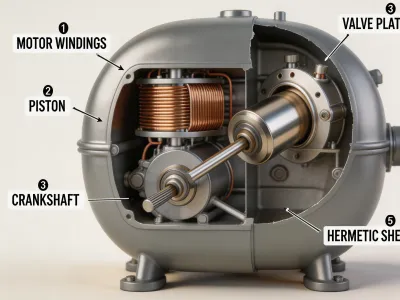
Piston-driven compression for medium-temperature and low-temperature refrigeration. Available in hermetic and semi-hermetic configurations with displacement volumes from 3.5 to 48 cm3. Optimized valve geometry reduces re-expansion losses and improves volumetric efficiency at high compression ratios.
| Parameter | Specification |
|---|---|
| Capacity Range | 1/12 HP to 3 HP |
| Refrigerants | R-134a, R-404A, R-290, R-600a |
| Evaporating Temp | -35 to +10 C |
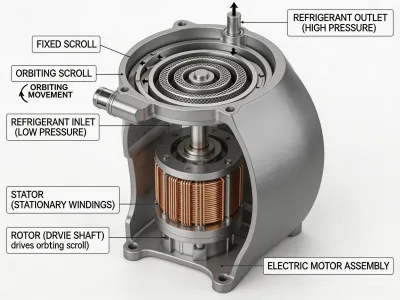
Rolling-piston and scroll compression for air conditioning and medium-temperature applications. Inherently low vibration and noise characteristics make rotary platforms suitable for noise-sensitive commercial installations. Inverter-compatible models support variable-speed operation for part-load efficiency gains of 25-35%.
| Parameter | Specification |
|---|---|
| Capacity Range | 1/4 HP to 5 HP |
| Refrigerants | R-32, R-410A, R-290 |
| Sound Level | Less than 52 dB(A) at 1m |
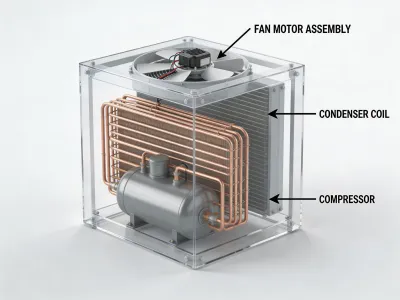
Factory-assembled condensing units combining TecumsehCool compressors with matched condenser coils, fan motors, and control packages. Pre-charged with refrigerant and electrical tested before shipment, reducing field commissioning time and minimizing installation error risk.
| Parameter | Specification |
|---|---|
| Capacity Range | 1/3 HP to 6 HP |
| Configurations | Air-cooled, indoor/outdoor |
| Pre-charged | Factory tested & charged |
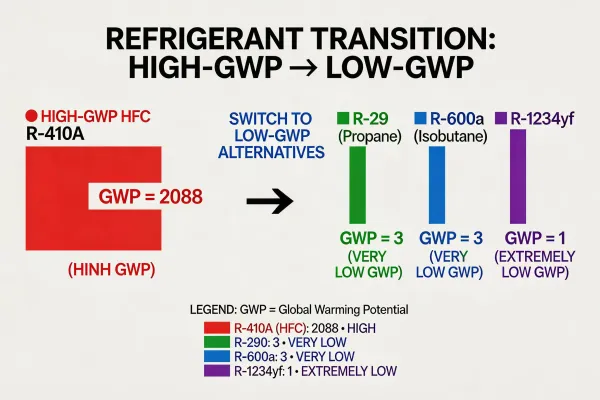
The global phase-down of high-GWP HFC refrigerants under the Kigali Amendment and EU F-Gas Regulation is fundamentally reshaping compressor design requirements. TecumsehCool has invested in platform-level adaptations to support both natural refrigerants (R-290 propane, R-600a isobutane) and next-generation synthetic alternatives (R-1234yf, R-1234ze).
Key engineering modifications for hydrocarbon refrigerant compatibility include:
Our R-290 compressor range achieved EPA SNAP approval and carries CE marking with compliance to EN 378 and IEC 60335-2-34.
Systematic optimization at every stage of the compression cycle to deliver measurable energy savings.
Proprietary reed valve designs reduce pressure drop across suction and discharge ports, improving volumetric efficiency by 3-5% compared to conventional flat-plate valves at the same displacement.
Copper stator windings with optimized slot geometry reduce I2R losses. Our permanent-magnet synchronous motor (PMSM) platform achieves IE4 Super Premium efficiency ratings on inverter-driven models.
Inverter-compatible compressor platforms modulate capacity from 30% to 100% of rated output, matching refrigeration load precisely and eliminating the energy waste of on/off cycling under partial load conditions.
Suction gas cooling of the motor cavity and optimized oil circulation paths maintain consistent lubrication and motor temperatures, extending bearing life and maintaining EER performance throughout the operating envelope.
Informed compressor selection requires understanding the performance boundaries and design compromises inherent in each compression architecture.
The choice between variable-speed (inverter) and fixed-speed compressor platforms involves measurable engineering trade-offs that depend on the application load profile and economic constraints.
Variable-speed platforms deliver 30-50% energy savings under part-load conditions by modulating capacity from 30% to 100% of rated output. This is particularly valuable in variable-load applications such as supermarket display cases and data center cooling, where thermal demand fluctuates with occupancy and ambient temperature. Inverter-driven models also provide precise superheat control, reducing suction gas temperature variance to within 1-2 K of setpoint.
Fixed-speed platforms offer 15-25% lower capital cost, simpler control wiring, and a larger installed base of trained service technicians. In constant-load applications such as industrial process cooling (injection mold cooling, chemical reactor jackets) and ice-making systems where the compressor operates near full capacity for extended duty cycles, fixed-speed units often achieve comparable lifecycle energy cost with lower upfront investment and maintenance complexity.
TecumsehCool offers both inverter-compatible and fixed-speed models across the hermetic and rotary platforms, allowing system designers to match the drive topology to the specific load profile.
The Kigali Amendment (2016) and revised EU F-Gas Regulation (2024) mandate the global phase-down of high-GWP HFC refrigerants. The industry remains divided on whether the optimal transition pathway leads to natural refrigerants or next-generation synthetic alternatives.
Natural refrigerants (R-290 propane, GWP=3; R-744 CO2, GWP=1; R-717 ammonia, GWP=0) offer zero or near-zero global warming potential and freedom from patent dependencies. However, R-290 carries IEC 60335-2-89 charge limits (typically 150g for commercial self-contained units), constraining system cooling capacity per circuit. R-717 presents toxicity and flammability risks requiring specialized ventilation and leak detection systems.
Synthetic HFOs (R-1234yf, GWP=4; R-1234ze, GWP=7) provide drop-in compatibility with existing HFC system architectures, reducing retrofit cost and retraining requirements. Drawbacks include higher refrigerant cost per kilogram (3-5x vs R-290), emerging concerns about PFAS-related environmental persistence of decomposition byproducts (trifluoroacetic acid), and patent-limited supply chains.
TecumsehCool compressor platforms are validated for both pathways: R-290 and R-600a natural refrigerants, plus R-1234yf and R-1234ze HFOs, giving system designers flexibility to select based on regional regulation and application requirements.
Understanding compressor performance limits is essential for reliable system design. The following parameters define the operating envelope for TecumsehCool platforms.
Air-cooled condensing units are rated for ambient temperatures up to 43 C (109 F). Operation above this threshold reduces cooling capacity by approximately 2-3% per degree Celsius and may trigger high-pressure safety cutouts. Applications in desert or tropical climates above 45 C ambient require water-cooled condenser configurations or supplementary shade structures.
R-290 propane compressor systems are subject to IEC 60335-2-89 refrigerant charge limits, typically 150g for commercial self-contained equipment. This constrains single-circuit cooling capacity to approximately 1.5 kW at standard rating conditions. Applications requiring higher capacity must use multiple independent circuits or transition to R-744 CO2 transcritical architectures.
Single-stage hermetic compressors operate efficiently down to -35 C evaporating temperature. Applications requiring temperatures below -35 C (pharmaceutical ultra-low freezers at -80 C, cryogenic processes) require cascade refrigeration systems with two separate compressor stages and intermediate heat exchangers, increasing system complexity and cost.
Variable-speed operation requires inverter-compatible motor windings with enhanced insulation (Class H or higher) to withstand voltage spikes from PWM drives. Not all hermetic compressor models in the current catalog support inverter operation. Applying an inverter drive to a non-compatible model risks premature motor winding failure due to partial discharge degradation.
Engineering documentation and application notes available to support system designers and OEM partners.
Online tool for capacity calculations, refrigerant selection, and model specification
Design guidelines for hydrocarbon refrigerant systems using TecumsehCool compressors
Piping, electrical, and commissioning procedures for standard condensing unit range
Model equivalency tables for legacy compressor replacement and upgrade paths
Our engineering team is available to review your application specifications, provide compressor performance data, and recommend the optimal platform for your project.
Schedule a Technical Consultation